What a baby snow monkey in Japan taught us about workplace belonging
Authored by PERSOL India, Editorial Team, India • 7 min read


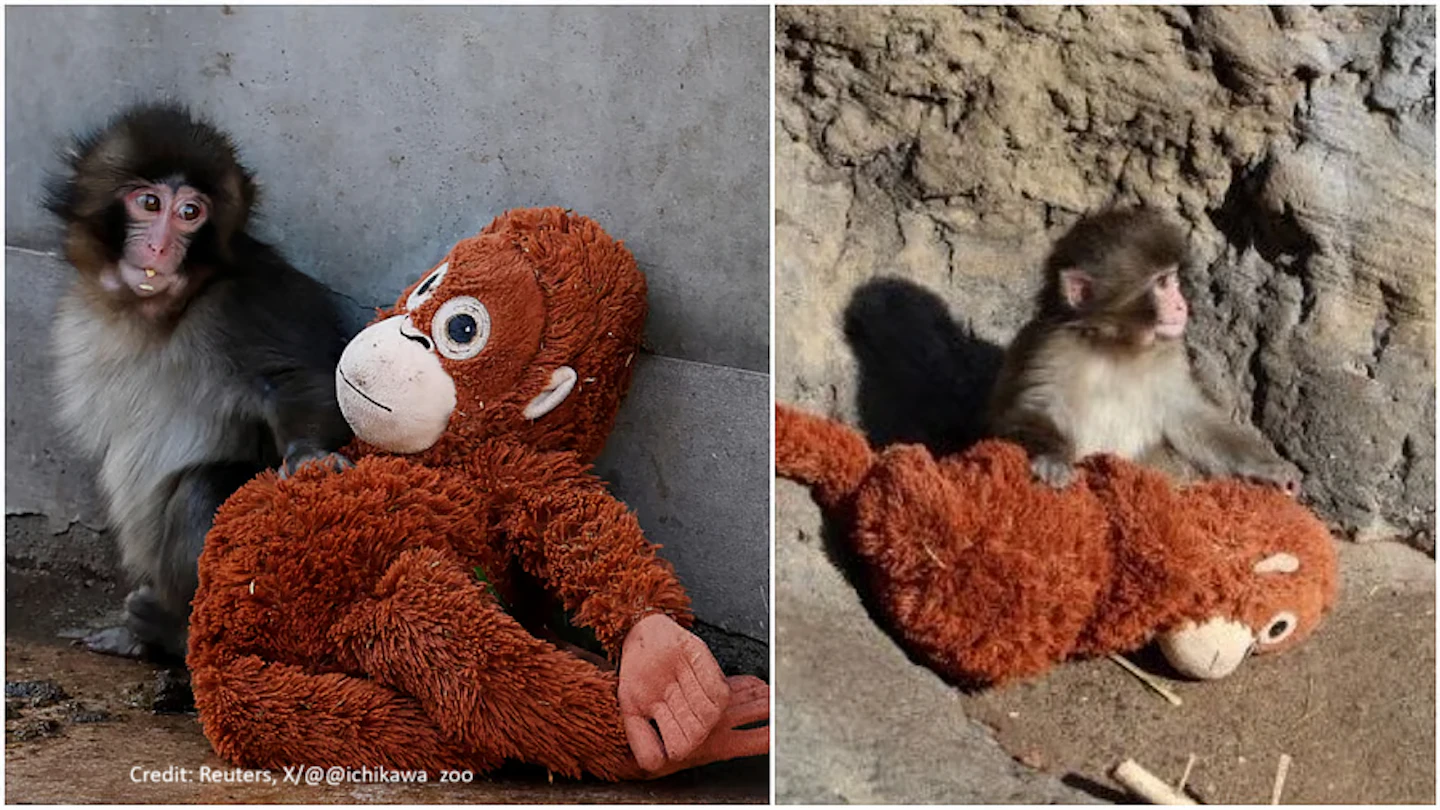
By now, you have probably seen him. A tiny baby macaque, barely the size of a fist, clinging to an IKEA stuffed orangutan like it's the only solid thing in the world. His name is Punch-kun : named after a beloved Japanese manga artist, and he lives at the Ichikawa City Zoo in Japan.
In February 2026, his story went viral. Not because it was cute (though it absolutely was). But because it was painfully, universally recognisable.
Punch was born in July 2025. His mother showed no interest in raising him. Caretakers hand-fed him, bottle by bottle, for months. Then, on January 19th 2026, they introduced him to Monkey Mountain , a social group of around 60 macaques where he had no allies, no history, and no blueprint for how to belong.
Zoo officials noted he showed "signs of anxiety and isolation." Other monkeys pushed him away. He had no maternal figure to model behaviour from.
Sound familiar? It should. This is happening in workplaces across Asia every single day.
The Monkey Mountain Problem
Most onboarding experiences are, if we're honest, a version of Monkey Mountain. Here's your laptop. Here's the team. There's a welcome email somewhere in your inbox. Good luck.
According to research by Gallup, only 12% of employees strongly agree their organisation does a great job of onboarding new employees. In high-growth markets like India, where companies are scaling rapidly - especially across GCC setups, technology functions, and BFSI - the gap between "joining" and "belonging" can stretch for months.
The emotional reality of starting a new job , particularly when you're new to a city, a company culture, or a cross-border work environment - is closer to Punch's experience than most organisations would like to admit. You're surrounded by people. You can see the social structures. But you don't yet know the unwritten rules. You don't have an ally. And sometimes, someone pushes you away.
The cost of this isn't just human. Research consistently shows that employees who experience poor onboarding are significantly more likely to leave within the first year. In a talent market as competitive as India's where demand for skilled professionals in tech, engineering, and financial services continues to outpace supply, and that's a risk no organisation can afford to take lightly.
What the Djungelskog Actually Represents
When zoo officials gave Punch a large stuffed orangutan an IKEA Djungelskog, as it turns out , they weren't solving the problem. They were buying him time. Creating a bridge until genuine connection could form.
The plushie became a surrogate mother. Something familiar and consistent in an environment that was neither. Something Punch could hold onto while he slowly, cautiously, built the confidence to engage with the real world around him.
In workplace terms, the Djungelskog is your onboarding buddy programme. It's the manager who does a 30-minute check-in at the end of week one, not to review deliverables, but just to ask "how are you actually finding it?" It's the peer who invites the new hire to lunch before they have to awkwardly ask. It's the structured touchpoint that makes someone feel seen before they've earned their place.
These are not soft or optional. They are the infrastructure of integration. And here's the thing IKEA understood that many organisations don't: when something is working, you don't remove it prematurely. When Punch went viral and IKEA visited the zoo, they donated 33 more stuffed toys : not one. They doubled down on what was helping.
How many companies pull back their onboarding support after week two, just as the new hire is starting to realise how much they still don't know?
The Keeper's Role: Onboarding Is Not a Document
Two caretakers hand-raised Punch from birth. Not a policy. Not a portal. Not an automated email sequence. Two actual humans who showed up, consistently, and paid attention.
This is the part that gets squeezed out of organisational onboarding faster than anything else: intentional human contact.
Good onboarding isn't HR's two-hour induction session followed by a checklist of compliance trainings. It's weeks , sometimes months of active, low-pressure presence. Someone who notices when a new hire goes quiet in meetings. Someone who explains the cultural context behind a decision, not just the decision itself. Someone who says "this confused me too, when I first started."
The question organisations need to ask themselves honestly is this: who in our structure is playing that keeper role for every new person we bring in? And are we giving those people the time, the brief, and the recognition to actually do it well?
What Integration Actually Looks Like
Here's the part of Punch's story that doesn't get shared as much.
By February 23rd 2026, just over a month after his difficult introduction to Monkey Mountain, the Ichikawa City Zoo reported that Punch was playing with other monkeys and able to eat independently, without requiring help from a caretaker.
That's the goal. Not permanent dependence on the stuffed toy. Not an employee who only feels safe talking to their buddy. But genuine integration , someone who can navigate the environment independently, build real relationships, and contribute from a place of confidence rather than survival.
This is what successful onboarding looks like as a measurable outcome. Not "completed compliance training by Day 5." But "feels like a genuine part of the team by Month 3." The metrics matter: engagement scores, early retention, time-to-productivity, manager satisfaction ratings in the first 90 days.
What the Punch-kun story captures so perfectly, and why it resonated with millions of people globally - is that this journey is not linear and it is not fast. There will be days when someone pushes the new hire away. There will be moments of anxiety and isolation that have nothing to do with their capability. What matters is that the structure around them holds.
Why "I Am Punch and He Is Me" Hit So Hard
When the story broke in February 2026, someone typed "I am Punch and he is me" into their family group chat. It got shared across the internet until it became a kind of collective confession.
Mary McNamara, writing in the Los Angeles Times, captured it well: "Everyone knows what it's like to feel small and bewildered as you circle a social group, seeking a way in, just as everyone knows what it's like to be rejected by those whose approval we seek."
This isn't just an internet moment. It's a workforce signal. If millions of working adults across the world saw themselves in an abandoned baby monkey clinging to a stuffed toy that tells us something important about how unsupported people feel in the environments they're supposed to thrive in.
The hashtag #HangInTherePunch trended globally. "We're ALL Punch's family now" became a rallying cry. People sent warmth to a zoo in Ichikawa City, Japan, from every corner of the world.
The best employers make that feeling true from Day 1 — not because it's a nice thing to do, but because it's the only thing that actually works.
What This Means for Organisations in 2026
At PERSOL, we work with organisations across APAC to build workforces that last, not just fill roles. And in our experience, the difference between a hire that sticks and a hire that walks within 12 months almost never comes down to skills or salary alone.
It comes down to whether that person felt, in the first weeks and months, that there was a structure around them that wanted them to succeed.
In an environment where GCC expansion is accelerating, where cross-border hiring is becoming the norm, and where India's talent landscape is more dynamic than ever - getting onboarding right isn't a nice-to-have. It's a business imperative.
Punch eventually found his footing. He started playing with the other monkeys. He learned to eat on his own. He became part of something.
Your new hires can too. But only if the structure around them is built to make that possible.
PERSOL India is one of APAC's leading workforce solutions providers, supporting organisations across recruitment, staffing, GCC hiring, and workforce integration. If you're thinking about how to build a workplace where people genuinely belong, we would love to talk.
Related Articles


Why Strong Candidates Lose Interest Between I...
Hiring top talent in South Korea is already challenging, but keeping ...
Why Strong Candidates Lose Interest Before th...
Hiring top talent in Indonesia is becoming more challenging, and many...
Why Good Candidates Drop Out Halfway Through ...
A strong candidate applies, performs well in the first interview and ...
Why Qualified Candidates in Singapore Say No ...
A qualified candidate may perform well in every interview, show genui...